
Sintered PTFE Spargers for High-efficiency and Green Development of Chlorination Reactions
Chlorination reaction serves as the core reaction process in the production of PVC and pesticides. Chlorination reactors are critically important for this process. The reaction is mainly a gas-liquid two-phase reaction between chlorine gas and liquid raw materials or liquid catalysts to generate target products.
In conventional production processes, chlorine gas is directly fed into the reactor through the outlet at the reactor bottom, without dedicated gas sparger equipment installed inside the reactor. Under such conditions, mixing and reaction between chlorine gas and the liquid phase system rely primarily on the agitation of the reactor stirrer.
Nevertheless, direct chlorine gas feeding has obvious limitations. Without an effective gas sparger mechanism, chlorine gas tends to distribute unevenly inside the reactor, and channeling is likely to occur. This not only limits the contact area between chlorine gas and the liquid phase but also greatly shortens the residence time of chlorine gas in the liquid layer. Insufficient gas-liquid mixing severely impairs reaction efficiency, resulting in incomplete reactions, waste of chlorine feedstock and prolonged reaction cycles.
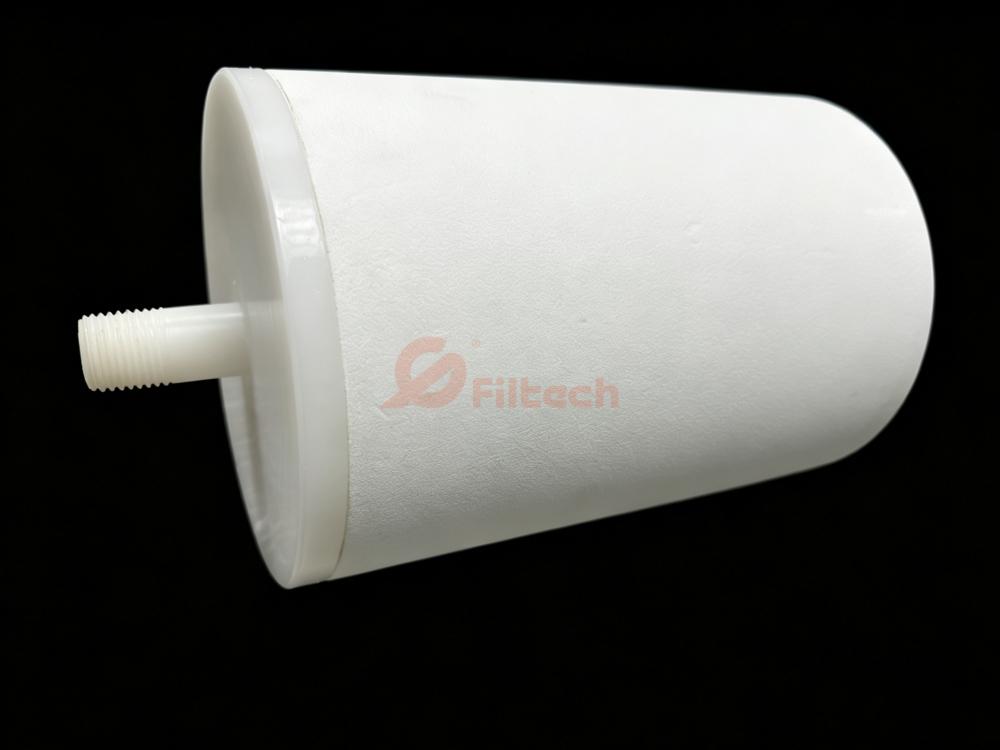
Leveraging its technical expertise in the field of microbubbles, Grand has developed an efficient and compact sintered PTFE distributor. This gas distributor features high mechanical strength and high-temperature resistance. With its unique structural design, it can act as a gas sparger component in gas-liquid/ gas-liquid-solid chlorination reactors, replacing traditional stirring paddles and perforated distributors, and substantially improving the efficiency and economic performance of chlorination reactions.
At present, the sintered PTFE distributors designed and manufactured by Grand have achieved technical breakthroughs in acetylene hydrochlorination units. The bubble reactor adopting sintered PTFE spargers as core components replaces conventional fixed-bed reactors. It delivers high reaction efficiency and enables the substitution of mercuric chloride catalysts with eco-friendly alternatives, realizing energy conservation, emission reduction and environmental sustainability.
Post time:2026-09-22